Once your basement walls are covered with drywall, the insulation behind them becomes difficult to inspect or replace. Gaps in insulation, uncontrolled moisture, and air leaks can eventually lead to uncomfortable temperatures, condensation, damaged finishes, and expensive repairs. Proper insulation planning helps prevent these problems before they become hidden behind finished surfaces.
By WMI Home Solutions
Once your basement walls are covered with drywall, the insulation behind them becomes difficult to inspect or replace. Gaps in insulation, uncontrolled moisture, and air leaks can eventually lead to uncomfortable temperatures, condensation, damaged finishes, and expensive repairs.
Proper insulation planning helps prevent these problems before they become hidden behind finished surfaces.
For homeowners in Grand Rapids and throughout West Michigan, spray foam insulation can improve basement comfort while reducing heat loss and controlling air movement. However, its long-term effectiveness depends on foundation conditions, moisture management, insulation selection, and installation quality.
These decisions are especially important when transforming an unfinished basement into a family room, home theater, bedroom, or office.
At WMI Home Solutions, we approach insulation as part of the complete basement construction process.
Our spray foam insulation service supports improved energy efficiency, indoor comfort, and moisture control. We focus on the building systems that help your finished basement remain functional and comfortable for years.
Book a free consultation with WMI Home Solutions to discuss spray foam insulation, moisture management, and the essential building systems that help protect your finished basement for years to come.
How Does Spray Foam Insulation Reduce Heat Loss in a Finished Basement?
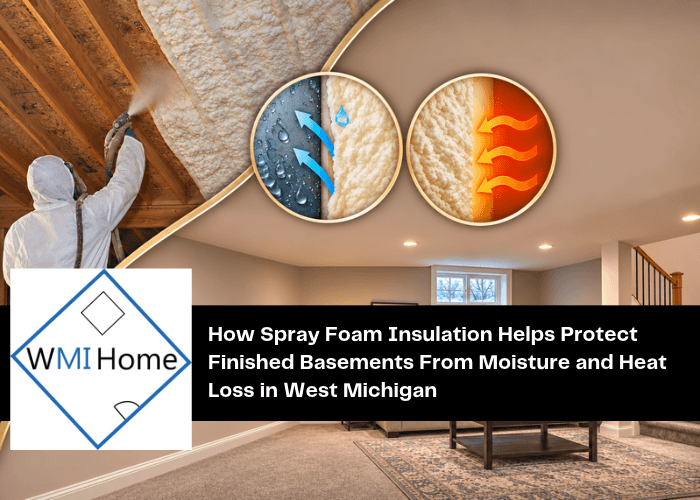
Spray foam insulation reduces heat transfer through basement walls while sealing gaps that allow conditioned air to escape. Its combined insulating and air-sealing properties help maintain more consistent indoor temperatures during West Michigan's cold winters.
How Insulation Improves Basement Comfort
Concrete foundation walls conduct heat, allowing warmth from conditioned spaces to move toward colder surrounding conditions. Continuous insulation helps reduce this heat loss.
Spray foam supports basement performance through:
- Thermal resistance: Slows heat movement through insulated surfaces.
- Air sealing: Reduces drafts through cracks, joints, and penetrations.
- HVAC efficiency: Helps reduce heating and cooling demands when incorporated into an effective building envelope.
Your basement's comfort also depends on ceiling construction and HVAC distribution.
Our blog, Basement Ceilings & Lighting Design in Grand Rapids: Built Around How You Live, explores how overhead systems influence finished living spaces.
How Does Spray Foam Insulation Help Control Basement Moisture and Condensation?
Spray foam insulation helps manage moisture by limiting air movement against cold foundation surfaces. Properly selected and installed foam also influences water vapor movement, reducing conditions that contribute to condensation within finished wall assemblies.
Understanding Condensation Behind Basement Walls
Warm, humid indoor air can condense when it contacts cold concrete. If moisture accumulates behind drywall, it can damage framing, insulation, and interior finishes.
Closed-cell spray foam creates an air barrier and provides vapor resistance at appropriate thicknesses. Applied continuously against a properly prepared foundation wall, it helps limit contact between humid indoor air and cold concrete.
However, spray foam cannot repair foundation cracks, stop active leaks, or replace waterproofing. Bulk water intrusion must be corrected before insulation begins.
What Should Be Inspected Before Installing Spray Foam on Basement Walls?
Basement walls should be evaluated for water intrusion, structural concerns, and existing moisture damage before spray foam installation. These assessments determine whether insulation can be installed safely and what repairs or drainage improvements are necessary.
Essential Pre-Installation Checks
- Foundation condition: Inspect cracks, deteriorating masonry, and signs of water penetration.
- Exterior drainage: Evaluate gutters, downspouts, grading, and water accumulation near the foundation.
- Interior moisture: Investigate damp surfaces, musty odors, efflorescence, or previous flooding.
- Utility connections: Identify plumbing, wiring, and mechanical components requiring coordination or future access.
For basements incorporating bathrooms or wet bars, underground plumbing must also be planned before construction conceals important connections.
Our blog, How Underground Plumbing Supports a Long-Lasting Finished Basement in Grand Rapids, explains why early system planning helps avoid disruptive repairs.
Is Closed-Cell or Open-Cell Spray Foam Better for West Michigan Basements?
Closed-cell spray foam is generally preferred for interior foundation walls because it provides higher thermal resistance per inch and greater moisture resistance. Open-cell foam can be appropriate in certain above-grade assemblies, but its vapor permeability and ability to absorb water require careful consideration in basements.
Closed-Cell Spray Foam
Closed-cell foam has a dense structure that provides strong air-sealing performance and greater resistance to water vapor movement at suitable thicknesses.
It is commonly selected for concrete foundation walls, rim joists, and other locations requiring thermal insulation and moisture-conscious construction.
Open-Cell Spray Foam
Open-cell foam expands readily and offers effective air sealing when installed at sufficient thickness. However, it allows substantially more vapor transmission and can retain water if exposed to leaks.
The appropriate material depends on the location, foundation conditions, assembly design, and applicable insulation requirements.
How Does Spray Foam Compare With Fiberglass and Rigid Foam Insulation?
Spray foam, fiberglass batts, and rigid foam boards provide different combinations of thermal resistance, air sealing, installation flexibility, and moisture performance. Selecting the appropriate material requires evaluating the entire basement wall assembly.
Comparing Basement Insulation Options
- Spray foam: Adheres to surfaces and fills irregular gaps, providing insulation and air sealing in one application.
- Fiberglass batts: Offer economical thermal insulation but require a separate, effective air barrier and appropriate moisture management.
- Rigid foam boards: Provide continuous insulation when fitted tightly, with properly sealed seams and edges.
Fiberglass should not be placed directly against moisture-prone concrete without an appropriate wall assembly. Rigid foam can provide effective basement insulation, while spray foam often simplifies coverage around irregular foundation surfaces.
Installation costs vary. Spray foam generally has a higher upfront material and installation cost than fiberglass, making long-term performance and application requirements important considerations.
Where Should Spray Foam Be Installed Before Basement Walls Are Finished?
Spray foam is commonly applied to basement foundation walls and rim joists where heat transfer and air leakage affect indoor comfort. The installation locations should be determined before framing, drywall, and other finishes limit access.
Critical Areas to Address
Foundation walls: Continuous insulation helps reduce heat transfer and limits humid indoor air from reaching cold masonry surfaces.
Rim joists and sill connections: These perimeter areas often contain small openings that allow outdoor air to enter. Spray foam can seal difficult gaps around the framing.
Penetrations and transitions: Pipes, cables, and structural intersections require appropriate air-sealing details.
Proper coordination becomes especially important during basement finishing, when framing and utility placement affect insulation coverage.
Projects involving egress windows also require careful coordination around window openings, seals, and drainage details.
Learn how these elements work together in our blog: Basement Egress Windows in Grand Rapids: What Goes Into Proper Installation and Long-Term Protection?.
What Installation and Michigan Building Requirements Affect Spray Foam Performance?
Spray foam installation must meet applicable Michigan residential energy, insulation, and fire-protection requirements. Proper thickness, continuous coverage, suitable installation conditions, and approved protective barriers all affect long-term safety and performance.
Insulation Thickness and Application Quality
Required insulation levels depend on the assembly and applicable energy code. The specified foam thickness must provide the necessary thermal performance and, where applicable, vapor-control properties.
Installation also requires clean, suitable surfaces and compliance with product temperature, ventilation, and curing instructions.
Uneven coverage, voids, or improper application can compromise insulation performance.
Thermal Barriers and Fire Safety
Spray foam typically requires an approved thermal barrier in occupied finished basements. Properly installed gypsum drywall commonly serves this purpose.
An ignition barrier is a different level of protection and cannot automatically substitute for a required thermal barrier. Specific requirements depend on the foam product, installation location, approved assembly, and applicable building code.
How Much Does Basement Spray Foam Insulation Cost in Grand Rapids?
Basement spray foam insulation costs depend on the area being insulated, foam type, required thickness, foundation condition, and installation complexity. The total investment also reflects necessary preparation, protective barriers, and coordination with other remodeling work.
What Influences Your Estimate?
Important pricing considerations include the size and accessibility of foundation walls, rim joist conditions, insulation specifications, and preparation requirements.
A basement with existing moisture damage may require additional repairs before insulation installation.
Planning insulation alongside bathroom remodeling or laundry room design also helps coordinate moisture-sensitive spaces, ventilation, and utility placement.
A project-specific assessment provides a more useful cost estimate than a general square-foot figure.
Why Choose WMI Home Solutions for Basement Spray Foam Insulation in West Michigan?
WMI Home Solutions incorporates spray foam insulation into a broader approach to basement comfort, moisture management, and energy performance. We consider how insulation works with the structure, mechanical systems, and finished layout to support lasting results.
Our Approach to Long-Term Basement Performance
Our focus includes:
- Evaluating existing basement conditions before finishing.
- Planning insulation and air sealing around the intended room layout.
- Coordinating framing, utility access, and finished wall construction.
- Considering moisture management and long-term maintenance needs.
Whether you're planning a home theater, guest bedroom, or family recreation space, we want the construction behind the walls to support everyday comfort.
You can learn more about us, explore our remodeling services, or see our projects to understand our approach to finished living spaces.
Call us: (616) 430-7228
Final Thoughts
Spray foam insulation can play an important role in keeping finished basements comfortable, energy-efficient, and protected against condensation-related problems. Its effectiveness depends on selecting the right material, correcting moisture problems, and coordinating installation with the complete basement construction plan.
A finished basement should remain comfortable and practical as your household's needs change. The insulation you install today will remain hidden behind the rooms your family uses for years.
Making those construction decisions carefully is one of the most valuable steps in protecting your basement investment.
FAQs: Spray Foam Insulation Protect Finished Basements in West Michigan
1. Is Spray Foam Insulation Good for Finished Basements in Michigan?
Yes. Properly installed spray foam provides thermal insulation and air sealing that help improve basement comfort. Closed-cell spray foam is commonly preferred for interior foundation walls because of its moisture-resistant properties.
2. Does Spray Foam Insulation Waterproof Basement Walls?
No. Spray foam helps control air movement and water vapor transmission, depending on the product and thickness. It does not repair foundation leaks or replace proper waterproofing and drainage systems.
3. Is Closed-Cell Spray Foam Better Than Open-Cell Foam for Basement Walls?
Closed-cell spray foam is generally preferable for below-grade foundation walls. It provides greater insulation value per inch and better moisture resistance. Open-cell foam requires additional consideration because it is more vapor-permeable and can absorb water.
4. How Long Does Spray Foam Insulation Last in a Finished Basement?
Properly installed spray foam can remain effective for decades when protected from moisture intrusion, physical damage, and inappropriate exposure. Its longevity depends on installation quality, environmental conditions, and maintaining the surrounding building assembly.
5. How Much Spray Foam Insulation Is Needed for Basement Walls in Grand Rapids?
The required thickness depends on the foam's insulation value, the wall assembly, vapor-control needs, and applicable Michigan energy requirements. A project-specific evaluation determines the appropriate insulation specification before installation.